Article
How I Mastered English Grammar (And How You Can Too)
October 25, 2026 · The English Class
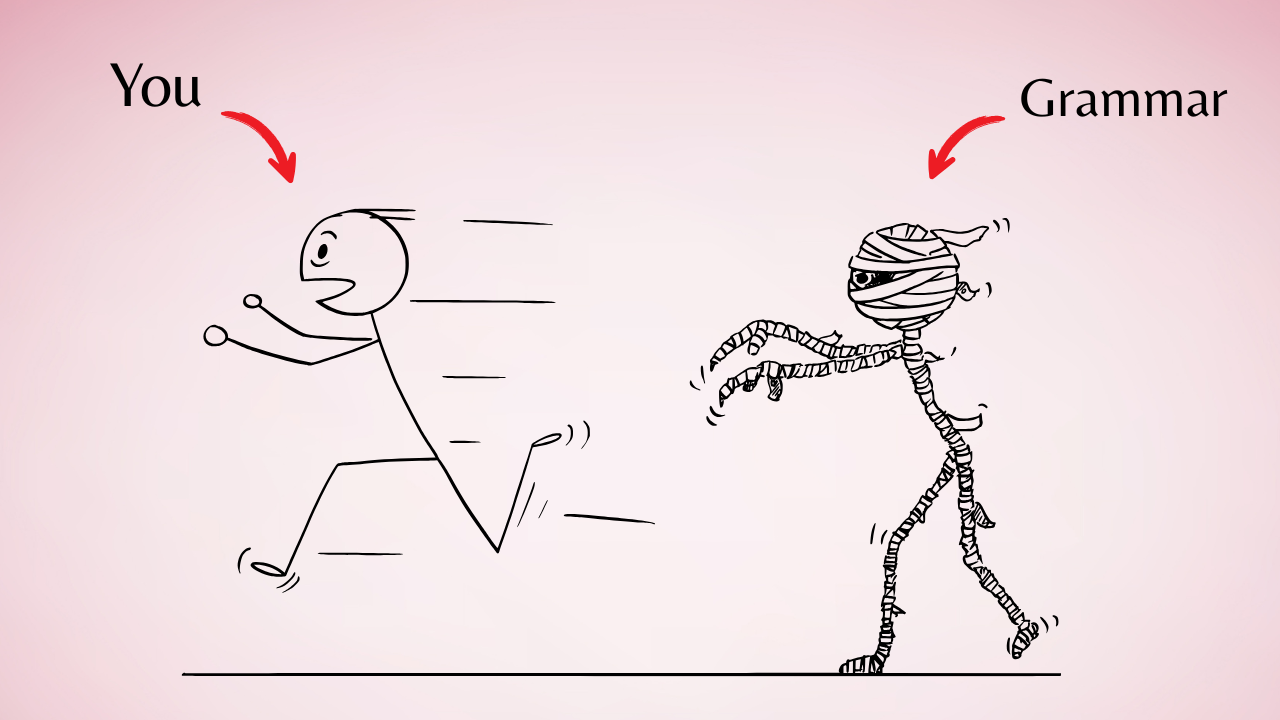
Let me tell you a secret: I was scared of English grammar. Yes, very scared.
Tenses, prepositions, articles… they all confused me. I used to look at grammar books and feel sleepy. Sometimes I felt stupid. I thought, “Maybe I will never learn. Maybe English is not for me.”
But one day, something small but powerful happened. From that day, grammar stopped being my enemy and became my friend.
Today, I’ll tell you that story, step by step. And remember: if I can do it, you can do it too.
My Struggle With Grammar
I remember my school days very clearly. My English teacher always said: “Learn the rules! Learn the grammar!”
But the rules were so hard to understand. Past perfect? Future continuous? So many big names and so many rules!
I memorized everything before the exam, and one day later, I forgot it all. I felt sad. I felt like a failure. Sometimes I didn’t even try. I thought, “Grammar is too hard for me. Only smart people can understand it.”
But deep in my heart, I still wanted to learn. I wanted to speak English with confidence. I just didn’t know how.
The Day Everything Changed
One day, I went to the library to look for a storybook. In the corner, I saw a man reading a grammar book, and he wasn’t looking serious. He was smiling!
I was shocked. I asked him, “Do you really enjoy grammar?”
He looked at me and said:
“Yes! Because I don’t just study grammar. I play with it. I learn grammar with fun, with examples, with real stories. Not only rules.”
It was a small idea, but it gave me hope.
My Simple Method: Learn Grammar Through Your Own Life
That night, I went home, looked at my old grammar books, smiled, and closed them. Then I picked up a notebook and wrote:
Day 1: Present Simple Tense
I didn’t read 10 pages. I just wrote 5 sentences about my day:
- I wake up.
- I brush my teeth.
- I eat breakfast.
- I go to work.
- I go to bed at 10 PM.
That’s it. It felt so easy!
Day 2: Past Simple Tense
The next day, I wrote the same sentences in the past:
- I woke up.
- I brushed my teeth.
- I ate breakfast.
- I went to work.
- I went to bed at 10 PM.
Just like that, I started learning grammar through my own life. I connected grammar with real things, not rules from a book, and that made a big difference.
4 Habits That Made Grammar Easy
1. I Talked to Myself in English
It sounds funny, but it really helped. Every evening, I asked myself: “What did I do today?” Then I answered in the past tense:
“I went to the market. I bought apples. I cooked lunch.”
2. I Watched Cartoons With English Subtitles
I paused the video, repeated the lines, and tried to say them with the same emotion as the characters.
3. I Wrote Small Stories
Very small, but full of practice. For example:
“Yesterday, I visited my grandma. She gave me sweets. We drank tea and talked about old stories.”
4. I Smiled at My Mistakes
When I made mistakes, I didn’t cry and I didn’t give up. I smiled, because every mistake was a small teacher. My mistakes taught me more than the rules did.
The Power of One Small Thing a Day
I didn’t study for 10 hours. I didn’t join expensive classes. I made just one promise:
“I will learn one small thing every day.”
| One day | = | One grammar point |
|---|---|---|
| One grammar point | = | One example |
| One example | = | One new sentence |
Slowly, I became stronger:
- In 3 months, I could use tenses easily.
- In 6 months, I started speaking better English.
- In 1 year, grammar was no longer scary. It became simple, normal, and my friend.
The 8 Parts of Speech: Building Blocks of English
Next, I learned about the parts of speech, the building blocks of English grammar. There are 8 of them:
| # | Part of speech | What it does | Examples |
|---|---|---|---|
| 1 | Noun | Names a person, place, or thing | teacher, city, book |
| 2 | Pronoun | Replaces a noun | he, she, it, they |
| 3 | Verb | Shows an action or state | eat, go, sleep |
| 4 | Adjective | Describes a noun | tall boy, red apple |
| 5 | Adverb | Describes a verb | walk slowly, speak loudly |
| 6 | Preposition | Shows place, time, or direction | on, in, at, before |
| 7 | Conjunction | Joins words or sentences | and, but, because |
| 8 | Interjection | Shows a feeling | Wow! Oh no! Hooray! |
Turn It Into a Game
I didn’t try to memorize them. Instead, I made silly sentences:
Wow! The red dog jumped on the table and barked loudly!
That one sentence has 7 parts of speech:
| Word | Part of speech |
|---|---|
| Wow! | Interjection |
| red | Adjective |
| dog, table | Noun |
| jumped, barked | Verb |
| on | Preposition |
| and | Conjunction |
| loudly | Adverb |
Can you make it 8? Add a pronoun:
Wow! The red dog jumped on the table, and it barked loudly!
Now all 8 parts of speech are in one sentence!
Start Your Own Grammar Journey
You don’t need to be perfect. You just need to be curious. Grammar isn’t just for exams; it’s for expressing yourself.
Start with three simple tenses using your own life:
| Tense | Example |
|---|---|
| Present | I eat rice. I go to work. |
| Past | I ate rice. I went to work. |
| Future | I will eat rice. I will go to work. |
That’s it. You’re already learning.
Practice: Your Grammar Notebook
Day 1 Challenge
Write 5 sentences about your day in the present simple tense.
Day 2 Challenge
Rewrite the same 5 sentences in the past tense.
Day 3 Challenge
Rewrite them in the future tense using will.
Bonus: Find the parts of speech
Identify the part of speech of each bold word:
Oh no! My little brother quickly ran to the park, but he forgot his ball.
- Oh no! → Interjection
- little → Adjective
- quickly → Adverb
- to → Preposition
- but → Conjunction
- he → Pronoun
- ball → Noun
- (ran → Verb)
Conclusion: Grammar Is Your Superpower
So now, when someone says “Grammar is boring,” I just smile, because I know the truth:
Grammar is not your enemy. It’s your superpower. You just have to use it the right way.
If a scared, confused, shy student like me can learn grammar, then you can too. Take one small step today, another tomorrow, and one more the next day.
Keep going. Don’t give up. And one day, someone will ask you, “How did you master English grammar?”
And you’ll smile and say: “Let me tell you a story…”