Article
How to Talk About Your Daily Routine in English (Easy Guide for Beginners)
October 24, 2026 · The English Class
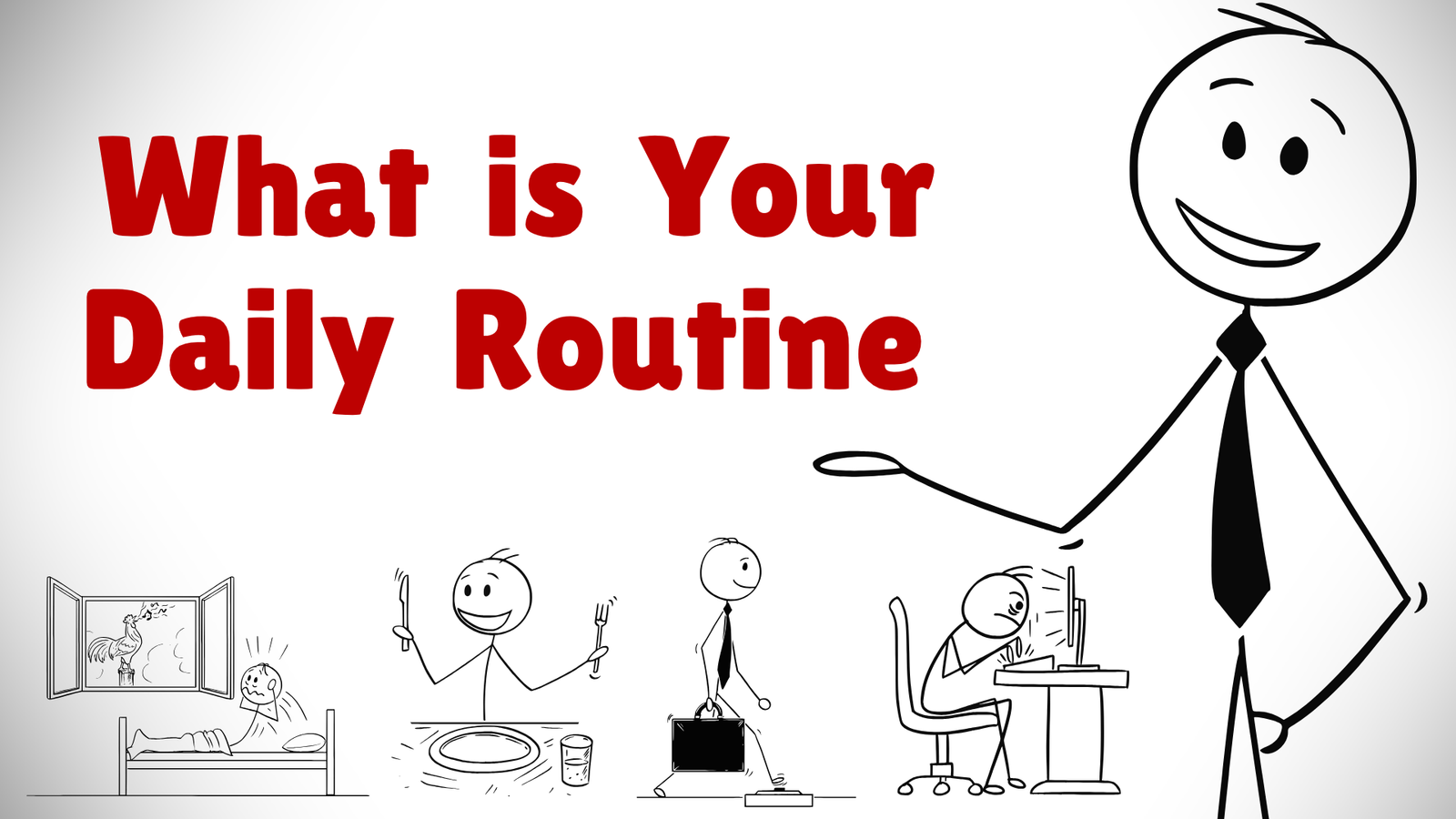
What do you do every day? You wake up, eat breakfast, go to school or work, and go to bed at night. This is your daily routine.
Talking about your daily routine is one of the first and most useful speaking skills in English. In this lesson, you will learn:
- The one grammar rule you need (Present Simple tense)
- Five linking words that make your English sound like a story
- A full daily routine example from morning to night
- Useful daily routine phrases
- A short practice exercise
Rule #1: Use the Present Simple Tense
When we talk about things we do every day, we use the Present Simple tense.
It’s very easy. With I, you, we, and they, use the basic verb:
- I wake up at 7 o’clock.
- We eat dinner together.
- They go to school.
The “Add -s” Rule for He, She, and It
When you talk about another person (he, she, it), add -s or -es to the verb:
| I / You / We / They | He / She / It |
|---|---|
| I wake up | She wakes up |
| I eat breakfast | He eats breakfast |
| I go to school | She goes to school |
| I watch TV | He watches TV |
| I brush my teeth | She brushes her teeth |
| I study English | He studies English |
Spelling tips:
- Verbs ending in -sh, -ch, -o, -s, -x → add -es (brushes, watches, goes)
- Verbs ending in consonant + y → change y to ies (study → studies)
- have → has (She has breakfast at 7.)
Rule #2: Use Linking Words to Tell a Story
If you only say short sentences, your English can sound like a list:
❌ I wake up. I brush my teeth. I eat breakfast. I go to school.
Add these five small words, and it sounds like a real story:
| Linking word | When to use it |
|---|---|
| First | The first thing you do |
| Then | The next step |
| After that | The next step (adds variety) |
| Next | The next step (adds variety) |
| Finally | The last thing you do |
Example
✅ First, I wake up. Then, I brush my teeth. After that, I eat breakfast. Next, I go to school. Finally, I go to bed.
See the difference? These small words connect your sentences and make your English sound natural.
My Daily Routine: A Full Example
Now let’s use both rules together and describe a full day, from morning to night.
Morning
I wake up at 7 o’clock in the morning. First, I brush my teeth. Then, I wash my face. After that, I eat breakfast. I drink milk and eat bread.
Next, I get ready for school. I put on my uniform and take my bag. I leave for school at 8 o’clock.
At School
At school, I study many subjects. I read books, I write in my notebook, and I talk with my friends.
At lunchtime, I eat my lunch. I eat rice and vegetables. Then, I play with my friends in the playground.
Afternoon
School finishes in the afternoon, and I come back home. I feel a little tired, so I drink some water and rest for a while.
Evening
In the evening, I do my homework. I write my answers carefully. After that, I play outside for some time. I run and laugh with my friends.
Later, I take a bath and put on clean clothes. Then, my family and I eat dinner together. We talk about our day.
Night
After dinner, I watch TV for a little while. Then, I brush my teeth again. Finally, I go to bed at 9 o’clock. I close my eyes and fall asleep.
Useful Daily Routine Phrases
| Morning | Day | Evening & Night |
|---|---|---|
| wake up | go to school / work | come back home |
| get up | study / work | do homework |
| brush my teeth | have lunch | have dinner |
| wash my face | talk with friends | watch TV |
| take a shower | play with friends | take a bath |
| have breakfast | finish school / work | go to bed |
| get dressed | rest for a while | fall asleep |
Common Mistakes to Avoid
| ❌ Incorrect | ✅ Correct |
|---|---|
| I take rest. | I rest / I take a rest. |
| I go to my bed at 9. | I go to bed at 9. |
| She go to school. | She goes to school. |
| He watch TV. | He watches TV. |
| I wear my uniform (as an action) | I put on my uniform. |
Tip: Wear describes what you have on (I wear a uniform to school). Put on describes the action of getting dressed (I put on my uniform at 7:30).
Practice: Your Turn
Exercise 1: Fill in the correct verb
- She ______ (wake) up at 6 o’clock.
- I ______ (eat) breakfast with my family.
- He ______ (watch) TV after dinner.
- My brother ______ (study) in the evening.
- We ______ (go) to bed at 10 o’clock.
Answers:
- wakes
- eat
- watches
- studies
- go
Exercise 2: Put these sentences in order using linking words
I eat breakfast. / I go to bed. / I wake up. / I go to work. / I brush my teeth.
First, I wake up. Then, I brush my teeth. After that, I eat breakfast. Next, I go to work. Finally, I go to bed.
Exercise 3: Write your own routine
Write 5–7 sentences about your day. Use the Present Simple tense and at least three linking words. Then read it out loud!